
Blog • Jun 5, 2026
Agentic Workflow Consultant Lessons from Meta's Tent Data Centers
Meta is building data centres in tents — the same move Tesla pulled on a car factory floor. The lesson for every agentic workflow consultant and AI automation agency isn't about infrastructure. It's about what you're willing to break on purpose.
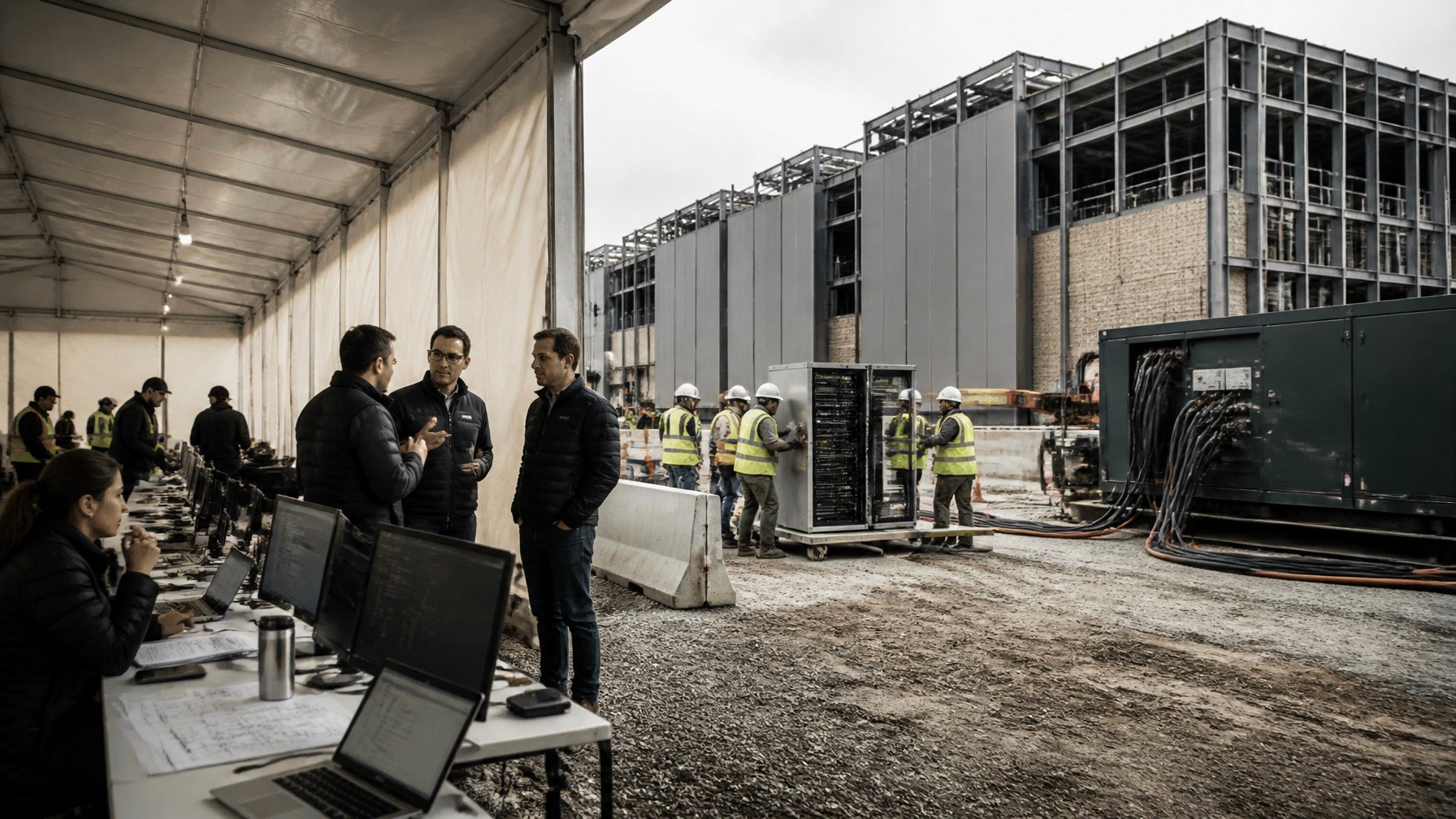
Why Meta's Tent Data Centres Are an Agentic Workflow Masterclass
On 4 June 2026, TechCrunch reported that Meta had begun erecting temporary tent structures over its data centre sites -- a tactic lifted directly from Elon Musk's playbook, when Tesla ran assembly lines inside a giant fabric tent outside the Fremont factory to hit Model 3 production targets. Meta's reasoning was identical: tents go up in weeks, not years. They cost a fraction of permanent construction. And they let you run real AI workloads now.
For any ai workflow automation agency or in-house RevOps team watching this, the tent is not the story. The story is the decision framework behind it: deploy something imperfect, learn under load, then build the permanent version with real data. That is precisely how production-ready agentic workflows should be built.
Modular Data Centre Thinking Applied to RevOps Automation
Here is what most B2B operations teams get wrong: they treat agentic workflows like a Salesforce implementation -- six months of requirements gathering, a polished demo, a big launch, and then a quiet realisation that the process it was meant to automate had already changed.
Meta's tent strategy is the antidote. Temporary data centre infrastructure for AI workloads is not a capex hack; it is a philosophy about when to commit. You run real traffic through a temporary data centre for AI workloads first. You learn what breaks. Then you pour concrete.
The modular data centre vs traditional data centre debate has always been framed around cost and deployment speed. That framing misses the point. The real advantage of modular data centre solutions is epistemic: you get signal before you lock in structure. For GTM and RevOps teams building multi-step agentic workflows, this is the only rational approach.
What Tesla's Tent Factory Lessons Actually Teach Agentic Workflow Consultants
Tesla's tent did not signal chaos. It signalled priority. Musk decided that learning what broke in production was worth more than waiting for a perfect facility. The tent was a deliberate choice to accelerate the feedback loop.
This is exactly what a senior agentic workflow consultant should be telling every B2B SaaS operations leader right now. Do not wait until your handoff process is perfect before you hire AI agents for RevOps automation. Deploy something narrow and observable. Watch it fail in interesting ways. Iterate.
The companies winning on agentic AI right now are not the ones with the most polished roadmaps. They are the ones that built a custom AI agent for one leaky GTM process, learned from it, and scaled what worked. That is not scrappiness. That is engineered experimentation.
How to Build Custom AI Agents for GTM Teams Without Overbuilding
Most organisations approaching an ai workflow automation consultant UK-based or otherwise arrive with a version of the same brief: "we want to automate our lead routing, our onboarding sequences, and our churn detection." That is three separate problems. Building all three at once is how you get an expensive system nobody trusts.
The tent approach looks like this:
1. Pick one GTM handoff that is broken right now. Not the most impressive one -- the most painful one.
2. Build a narrow, observable AI agent for business process automation around that single handoff. Log everything.
3. Run it live for four weeks. Not in staging. Not in a sandbox. Live.
4. Use the failure data to design the next agent and the permanent architecture.
This is how you build custom AI agents for GTM teams that actually get used. Not by designing for perfection upfront, but by designing for learning under real conditions.
The Agentic Workflow Consultant for B2B SaaS: What the Tent Asks Of You
Meta is spending over $60 billion on AI infrastructure in 2026 alone. They are not using tents because they cannot afford concrete. They are using tents because they have learned that committing to structure before you have signal is an expensive form of arrogance.
For a B2B SaaS company trying to hire AI agents for RevOps automation, or for a RevOps automation agency advising one, the same logic applies. Your first agentic workflow should not be your best one. It should be your most informative one.
This is where most engagements fail. The buyer demands a production-ready agentic workflow on day one. The agency overengineers to meet that demand. And six months later, the workflow is technically sound and completely disconnected from how the team actually operates.
The agentic workflow consultant for B2B SaaS who delivers real value is not the one who builds the most elaborate system. It is the one who knows when to put up a tent.
What funnpl Looks for Before We Pour Concrete
At funnnl, we do not start engagements by designing the final architecture. We start by identifying the one GTM or RevOps process that is leaking revenue right now, and we build the smallest possible agentic workflow that gives us real signal on it.
That might be a single AI agent that monitors deal stage transitions and flags anomalies to a Slack channel. It might be a multi-step agentic workflow that qualifies inbound leads and routes them based on real-time CRM context. Either way, we run it live before we recommend anything permanent.
We call this the tent phase. And in our experience working with B2B SaaS operations teams across the UK, US, and South Africa, it is the phase that determines whether the permanent build actually works.
The Question Your Operations Team Should Be Asking
Meta spent billions learning that temporary infrastructure is not a compromise. It is a strategy.
If your organisation is evaluating agentic AI -- whether you are looking to hire an agentic workflow consultant, engage an ai workflow automation agency, or build in-house -- the right first question is not "what should our final architecture look like?"
The right first question is "which process can we put a tent over this week?"
Because the companies that will own agentic GTM in 2027 are not planning it right now. They are running it.