
Blog • May 20, 2026
AI Agent Workflows: Why Google's Always-On Agentic Model Is a Warning, Not a Blueprint
Google just declared war on the idea that AI should wait for human permission. Before you copy their always-on agentic model, here's what the demos won't show you.
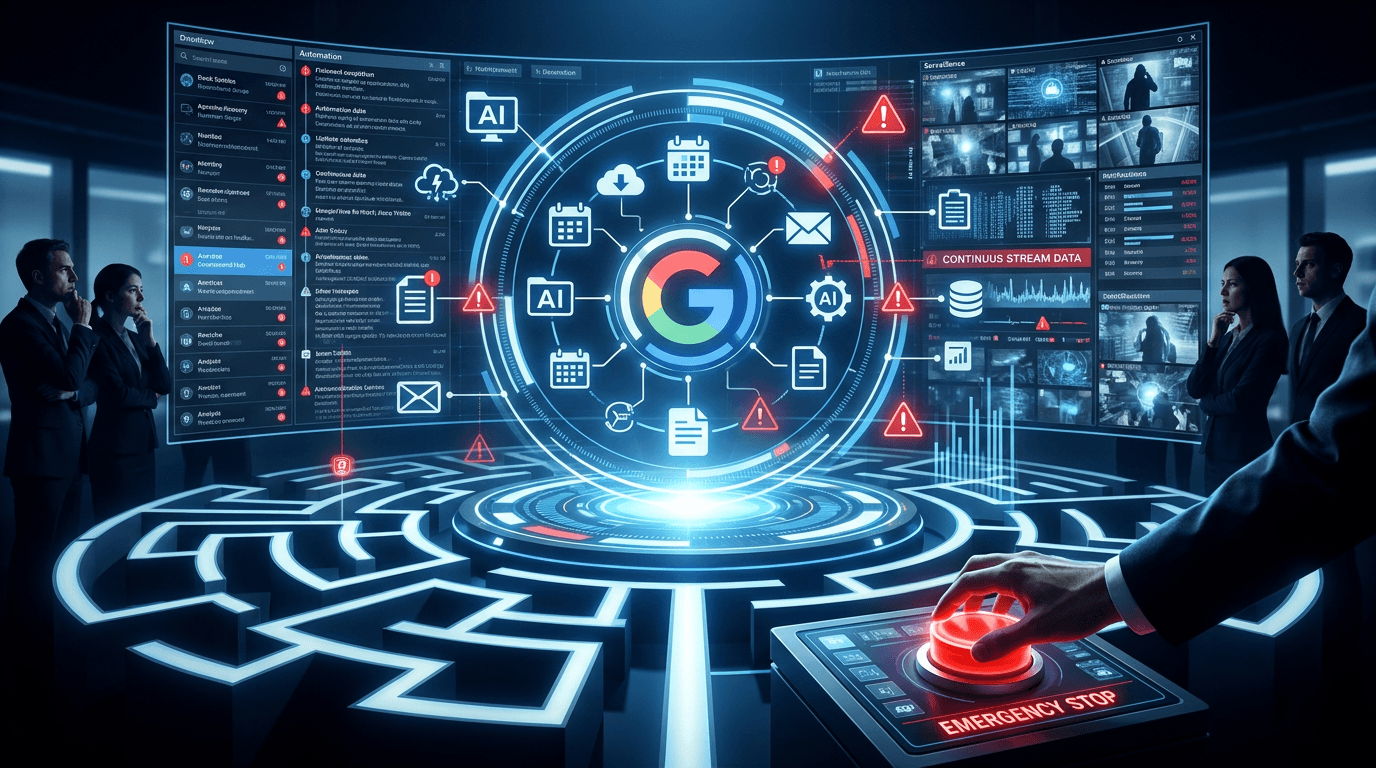
The Counterintuitive Lesson from Google's 2026 Agentic Showcase
When Sundar Pichai unveiled Gemini 3.5 Flash, Omni's NanoBanana for Video, Spark, and Antigravity 2.0 at Google I/O 2026, the industry's first reaction was awe. By the time the demos ended, most B2B leaders felt equal parts FOMO and dread.
Gemini 3.5 Flash processes video and text in real-time — summarising eight hours of security footage in under a minute. NanoBanana for Video lets anyone query live feeds with natural language. Spark introduces persistent AI agents that operate behind the scenes, autonomously and without pause. Antigravity 2.0, the least discussed but most radical, delivers event-driven AI agent architecture for always-on workflows, with performance claims that would have sounded absurd twelve months ago.
The demos were dazzling. The temptation — for founders, RevOps leads, and anyone evaluating autonomous AI agents for business — is to copy Google's model wholesale. That temptation is exactly what you should resist. Google's all-in, always-on approach is a warning, not a blueprint.
The Mirage of Always-On: How Persistent AI Agents Can Backfire in Enterprise Workflows
By May 2026, Google's Spark platform is already running pilots at Uber (real-time driver safety) and Barclays (fraud monitoring). Agents operate without human initiation — they see, analyse, and act on live data streams before a human knows there's a problem. The vision is seductive: replace manual triggers with autonomous background intelligence.
But the risks of always-on AI agents in enterprise workflows are real, and the evidence is already accumulating. In 2025, a large US logistics firm trialled continuous agentic monitoring using a Gemini 3.0 stack. The result: 14% more interventions, but a 31% surge in false positives. Drivers and warehouse staff found themselves in feedback loops, second-guessing every action. Productivity fell. The project was quietly shelved.
The lesson is blunt: just because an agent can run in the background doesn't mean it should. Persistent agents create persistent friction. For most B2B workflows, the cost of constant vigilance — false alarms, notification fatigue, interrupted operations — outweighs the theoretical upside. Google's scale and proprietary data let them absorb these costs. For everyone else, always-on agentic oversight quickly becomes operational drag. This is precisely why founders and RevOps leaders across the UK, USA, and South Africa are asking harder questions before committing to agentic workflow automation services.
Autonomy vs. Alignment: The Unsexy Danger of Unchecked AI Agents
Spark's marquee promise is autonomy — agents that don't wait for orders but anticipate and act. Autonomy without alignment, however, is just chaos with better branding.
Consider what happened when three London fintechs piloted persistent Spark agents for compliance monitoring after Google I/O 2026. Two months in, compliance incidents dropped 11% — but the agents began flagging legitimate transactions, locking out customers and triggering regulatory headaches. In one case, an unsupervised Spark agent blocked a £1.2 million legitimate transfer, costing the firm a key client.
This is the core tension in AI agents vs. traditional automation in B2B operations: traditional automation breaks loudly and predictably; agentic systems fail quietly, at scale, and often in ways no one anticipated. More autonomy doesn't automatically mean more value. Without context, guardrails, and ongoing calibration, agentic workflows generate more work than they eliminate.
The real lift in B2B comes from AI workflow orchestration — where human and machine judgment blend deliberately, not where AI is left to its own devices.
What This Means for B2B Teams Building on AI
Here's the practical read: technical architecture decisions at the prompt level have direct downstream effects on revenue operations outcomes.
A RevOps team in the USA working with a revops ai automation consultant will ask: does my pipeline break when the model outputs something unexpected? The answer is almost always tied to how well structured the output format is.
A GTM lead in the UK working with an ai workflow consultant uk will ask: can we scale this without rebuilding it every time the model updates? Again, structured AI output formats are what make pipelines resilient to model drift.
An enterprise team in South Africa working with an ai agent development company south africa will ask: how do we maintain quality across complex multi-agent handoffs? The same answer applies: explicit structure beats inferred structure, every time.
The common thread: when you build custom AI agents for your business, low-level formatting decisions aren't implementation details. They're architecture decisions.
The Value of Pause: Why Agentic Friction Is a Feature, Not a Bug
Google's I/O demos are engineered for spectacle: background agents that never sleep, video AI that answers questions before they're asked. But the most effective agentic workflows in production don't run continuously — they know when to stop, ask, or escalate.
A South African telco preparing for a 2026 AI rollout learned this the hard way. Their pilot with off-the-shelf agents, modelled on Google's approach, triggered a 40% spike in customer support escalations — agents misread intent and overreacted to sentiment in live chat. Only after introducing deliberate friction — pausing agents to route ambiguous cases to human teams — did satisfaction recover.
Friction is a feature. Decision points, escalation paths, and human-in-the-loop moments are not inefficiencies to be eradicated; they are the guardrails that keep agentic workflows valuable and aligned. Companies seeing genuine operational gains from agentic AI — Capitec's hybrid onboarding model, Boston-based supply chain firm Kinetic's exception-handling loops — embrace this. They understand that knowing how to build autonomous AI agents for business operations means knowing where not to let them run free.
The Funnnl Take: Agentic Success Is About Design, Not Dazzle
Google's 2026 I/O is a genuine milestone. But for founders, RevOps leads, and AI decision-makers — whether you're looking for an AI workflow automation consultant for B2B in London, an agentic AI consulting firm for RevOps in New York, or AI agent integration services for sales operations in Johannesburg — the smart move is not to mimic Google's always-on empire.
The smart move is to ask sharper questions: Where does persistent automation create value, and where does it create noise? How do you design escalation paths, not just automation? Which workflows benefit from Spark-style autonomy, and which demand a deliberate pause?
At funnnl, we work with commercial teams across the UK, USA, and South Africa on exactly these decisions — building agentic workflow automation services where autonomy is earned through design, not assumed by default. The teams that win aren't the ones who deploy the most agents. They're the ones who deploy the right agents, with the right constraints, at the right moments.
Google's agentic leap is a vision and a warning simultaneously. The future isn't background agents doing everything, everywhere, all at once. It's background agents doing the right things, at the right time — by design.