
Blog • May 16, 2026
AI Orchestration Consultant Thinking: Why the Conductor Layer Beats Smarter Agents
Every board wants the smartest AI agent. The companies pulling ahead in 2026 are buying something quieter—and far more powerful: the orchestration layer that makes every agent perform.
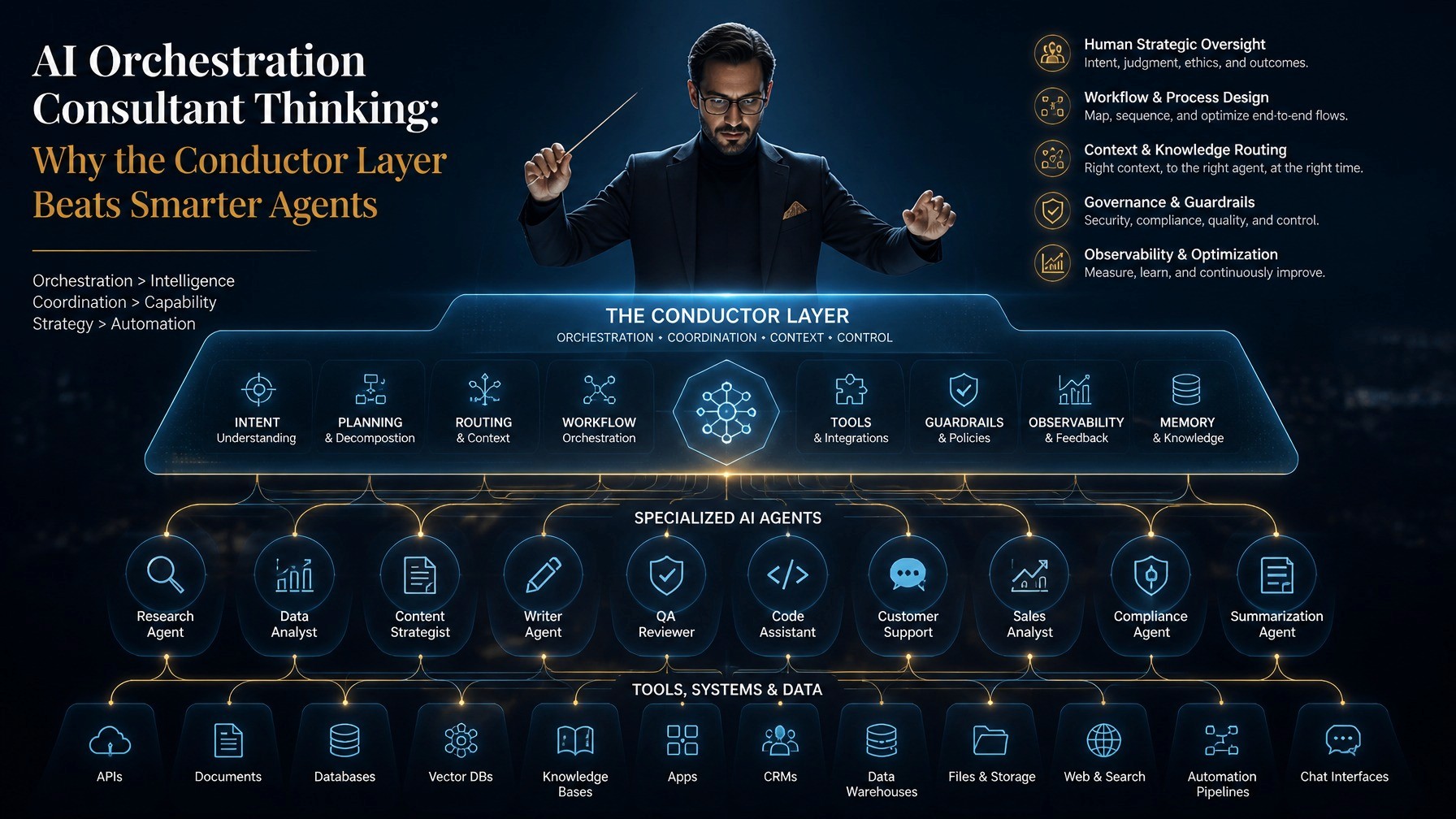
The Unseen Revolution: From Soloists to AI Orchestration
OpenAI's GPTs, Microsoft's Copilot, Anthropic's Claude—these are the names B2B founders and RevOps leads bring to every board meeting. You've probably piloted two or three in the last quarter. Yet while the AI news cycle churns through feature launches and API upgrades, a less flashy but far more disruptive shift is changing where value actually accrues.
Everything is becoming a conductor. Not a smarter agent. Not a better tool. A conductor. And if you're evaluating agentic AI platform implementation right now, you're likely looking in the wrong place.
In May 2026, AINews published 'Everything is Conductor', arguing that the orchestration layer—coordinating swarms of agents, connecting disparate data sources, automating workflows across teams—is quietly becoming the new centre of gravity in the AI stack. It's a counterintuitive shift already reshaping competitive advantage across the UK, South Africa, and the US.
The Counterintuitive Edge: Orchestration Beats Raw Intelligence
The default assumption is that the smartest agent wins. More context-aware customer support? More contracts. Better anomaly detection in financial forecasting? Better KPIs. That's been the logic of AI procurement since 2022, reinforced by every press release from Palo Alto to London.
2026 is proving that logic incomplete. In late 2025, Stripe invested in an internal orchestration platform—code-named 'Maestro'—to coordinate everything from risk assessment to customer onboarding rather than building ever-smarter financial agents. The result: a 23% reduction in operational lag and a 14% lift in customer satisfaction scores across EMEA (Stripe Q1 2026 Earnings). Models didn't get smarter. Workflows got orchestrated.
Salesforce's 'Flow Orchestrator', rolled out in Q4 2025, lets non-technical teams sequence AI agents, RPA bots, and human approvals without writing a line of code. In pilot deployments with a major UK insurance group, it shaved three days off claims processing—purely by letting the conductor manage hand-offs, context, and dependencies.
Here's the uncomfortable truth for anyone still running agent-selection RFPs: intelligence is abundant. Orchestration is scarce. The winner isn't the agent with the biggest dataset; it's the organisation with the best conductor keeping the entire symphony in sync. For enterprises looking to build cross-platform agentic AI workflows, that distinction is now the difference between operational drag and genuine scale.
Why B2B Buyers Are Rethinking Agentic Workflow Automation for Revenue Teams
If you're a COO in Johannesburg or a RevOps lead in Manchester, this shift has direct procurement consequences. Most RFPs still ask for 'the most advanced LLMs' or 'AI-powered task automation'. Vendors respond with feature charts listing agent capabilities—an arms race where every tool claims to be the smartest in the room.
The real friction in enterprise AI isn't intelligence. It's coordination. Teams are drowning in disconnected SaaS silos, fragmented APIs, and overlapping automations that break whenever underlying data changes. The cost isn't in model training; it's in failed hand-offs, missed context, and manual patchwork keeping the workflow from collapsing.
Consider a multinational logistics firm in Cape Town in early 2026. They deployed five best-in-class AI agents—routing, pricing, customs, compliance, customer comms. Each worked well in isolation. Shipments still got delayed because agents couldn't coordinate when exceptions arose. A conductor platform layered on top of the existing stack reduced exception-handling time by 40% and saved R28 million in lost revenue per quarter (internal case study, April 2026).
This is precisely why founders and operators across the UK and South Africa are beginning to hire AI orchestration consultants for B2B rather than simply procuring another point solution. Individual agent IQ is table stakes. Workflow IQ—how well those agents play together—determines who wins the contract, the renewal, and the loyalty. Agentic workflow automation for revenue teams isn't about replacing your stack; it's about making your stack coherent.
The New Battleground: What to Demand From an Agentic AI Platform
If multi-agent orchestration services are the new kingmaker, what actually matters when you're evaluating platforms?
Composability. Look for platforms that let you assemble new workflows from existing agents, APIs, and datasets without months of integration pain. UiPath's 'Studio Web' and Zapier's 'Canvas' offer drag-and-drop interfaces, but the leaders go further. funnnl's projects in the US and UK use modular agent blocks rearrangeable by non-engineers, cutting deployment times by more than 50%.
Context management. The best conductor platforms maintain persistent context across agents, sessions, and data sources. Anthropic's 'Claude Orchestrator', launched March 2026, introduced a memory layer tracking conversation state across 12 agents simultaneously—cutting error rates in customer service workflows by up to 30% (Anthropic Customer Summit, April 2026). This is the AI agents orchestration layer enterprises have been waiting for.
Error handling and escalation. Orchestration isn't just about the happy path. The winners build in exception management, real-time alerting, and human-in-the-loop escalation. Microsoft's Copilot Studio, now live with several Fortune 500s, auto-routes failed automations to a human operator within 60 seconds—turning failures into learning loops, not dead ends.
Cross-boundary coordination. Across every geography—and especially for firms operating across UK, South African, and US jurisdictions simultaneously—regulations, data residency, and compliance add real complexity. The best conductor platforms handle cross-system authentication, audit trails, and policy enforcement without locking you into a single vendor's ecosystem. This is where enterprise-scale agentic AI operating system thinking separates genuine solutions from rebranded middleware.
What the Market Gets Wrong—and What to Do About It
Boards still ask for the smartest chatbot, the most accurate summariser, the cleverest anomaly detector. The value, however, is rapidly flowing to those who can orchestrate—not those who can merely automate.
This means your procurement process needs a different set of questions. Instead of asking vendors how smart their agents are, ask how well their AI workflow automation layer handles:
- Live context sharing across agents and sessions
- Rapid composition of new workflows without engineering bottlenecks
- Automated error handling and clean human hand-offs
- Secure, compliant integration with legacy and third-party systems across jurisdictions
Whether you're looking to design custom agentic workflows for RevOps, or need agentic AI consulting services in the UK, or are evaluating an AI workflow automation agency in South Africa—the questions above will separate orchestration-first partners from vendors still selling agent horsepower.
It's the difference between owning a fleet of Ferraris and having a Formula 1 pit crew keeping them tuned, coordinated, and winning races. The firms getting this right—often quietly, sometimes with partners like funnnl—are reducing operational drag, unlocking new revenue streams, and scaling without the compounding failures that plague soloist-heavy stacks.
The real work in 2026 isn't building the smartest agent. It's building the best conductor. That's where value lives. That's where differentiation compounds.