
Blog • May 19, 2026
HTML vs Markdown for AI Agents: Why Anthropic's Switch Defies Agentic Workflow Logic
Every AI workflow consultant told you Markdown was the move. Anthropic's engineers quietly proved them wrong—and the reason matters for how you build.
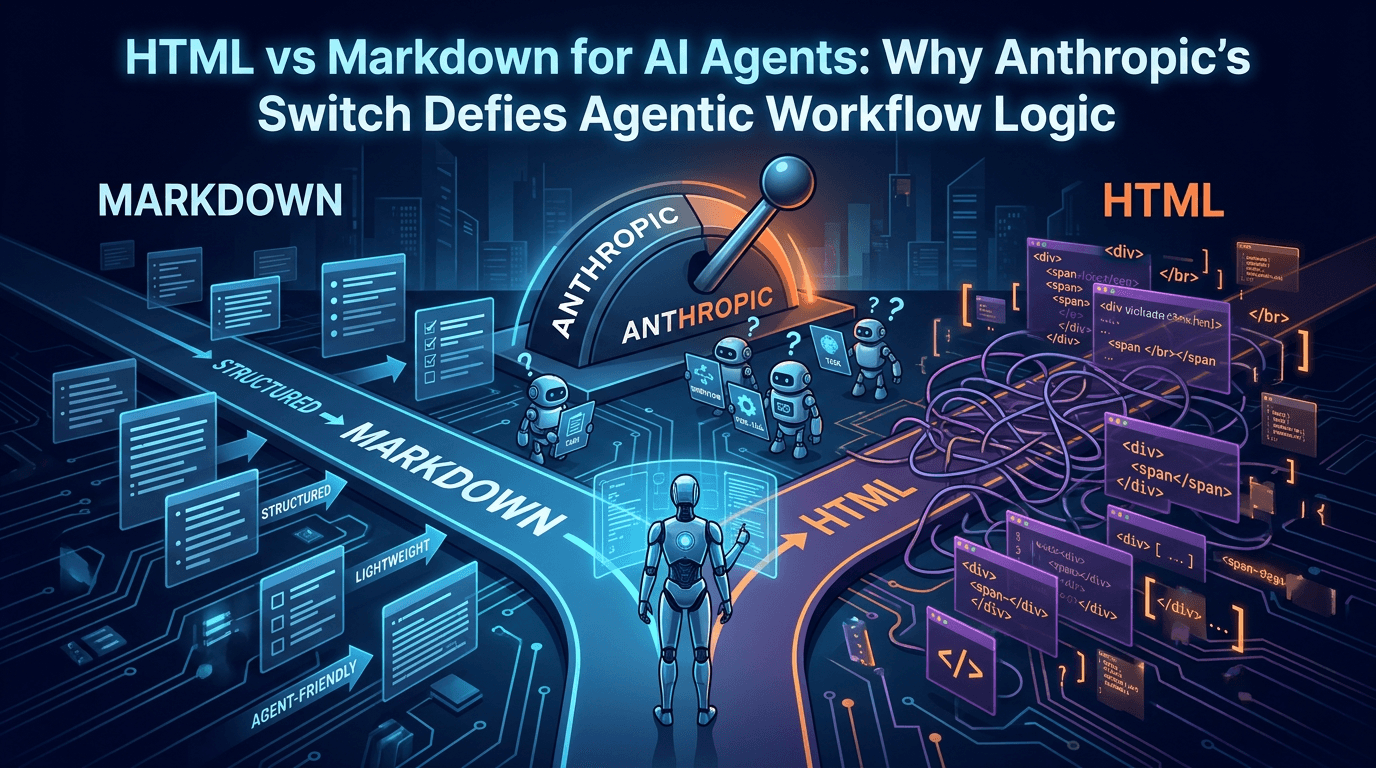
HTML vs Markdown for AI Agents: Why Anthropic's Switch Defies Agentic Workflow Logic
Every AI workflow consultant told you Markdown was the move. Anthropic's engineers quietly proved them wrong and the reason matters for how you build.
Markdown has dominated agentic workflows for years. Ship fast, read fast, iterate fast the logic was sound. Then Anthropic's engineers ditched it.
In May 2026, the team building on top of Claude Code made a deliberate choice: HTML over Markdown for structured AI output. Not as a stopgap. As a standard. And they stand behind it.
If you're an ai agent development company, a RevOps lead evaluating an ai workflow automation consultant, or a GTM team looking to build custom AI agents for your business, this decision has direct implications for your. Here's why.
Why Did Anthropic Switch from Markdown to HTML?
Markdown's strength is also its weakness: it's ambiguous by design. A heading can be rendered as a visual element or parsed as raw text, depending on the renderer. A bullet list means something different to a human reader than it does to an AI agent parsing it as input.
HTML removes that ambiguity. Every element has an explicit, machine-readable meaning. A `<table>` is a table. A `<section>` is a section. There's no interpretation layer between the prompt and the agent.
Anthropic's engineers reported spending roughly 30% less time debugging agentic micro-apps after the switch. That's not a marginal gain. That's a structural one. The answer to why did Anthropic switch from markdown to html isn't aesthetics or convention—it's reliability at scale.
HTML Prompts vs Markdown Prompts for AI Agents: What Actually Changes
This isn't about preference. It's about how AI agents process structure.
When you write a Markdown prompt, you're asking the model to infer structure from syntactic convention. When you write an HTML prompt, you're declaring structure explicitly. For agentic workflows where output from one agent becomes input for the next, that distinction compounds with every handoff.
Consider how you design agentic workflows for B2B revenue teams: a qualification agent passes structured account data to an outreach agent, which passes sentiment signals to a routing agent. At each step, ambiguous formatting introduces parsing risk. HTML eliminates that risk by making every data boundary explicit.
Is HTML better than Markdown for structured AI output? In multi-agent pipelines where parsing accuracy is non-negotiable, yes. For a simple single-turn response? Maybe not. Context still matters. But if you're building anything with ai agent orchestration across multiple steps, the case for HTML is strong.
What This Means for B2B Teams Building on AI
Here's the practical read: technical architecture decisions at the prompt level have direct downstream effects on revenue operations outcomes.
A RevOps team in the USA working with a revops ai automation consultant will ask: does my pipeline break when the model outputs something unexpected? The answer is almost always tied to how well structured the output format is.
A GTM lead in the UK working with an ai workflow consultant uk will ask: can we scale this without rebuilding it every time the model updates? Again, structured AI output formats are what make pipelines resilient to model drift.
An enterprise team in South Africa working with an ai agent development company south africa will ask: how do we maintain quality across complex multi-agent handoffs? The same answer applies: explicit structure beats inferred structure, every time.
The common thread: when you build custom AI agents for your business, low-level formatting decisions aren't implementation details. They're architecture decisions.
The Broader Lesson for Agentic AI Consulting
Anthropic's switch isn't a story about HTML versus Markdown. It's a story about what happens when you optimise for readability at the expense of machine parsability.
Most teams adopt Markdown because it feels lighter. And in single-agent, single-turn contexts, it often is. But agentic AI consulting engagements consistently show that as workflow complexity increases—more agents, more handoffs, more conditional logic, more downstream systems depending on clean output—Markdown's ambiguity becomes a liability.
The best agentic AI consulting firms aren't just designing workflows. They're making architectural calls at every layer—including the prompt layer. The difference between a workflow that scales and one that fragiles out at volume often comes down to exactly these kinds of choices.
Simplicity isn't always simple. Sometimes the more explicit path is the one that actually scales.
Funnnl builds agentic workflows for B2B revenue teams across the UK, South Africa, and USA. If you're evaluating how to build or scale AI agents for your business, talk to us.